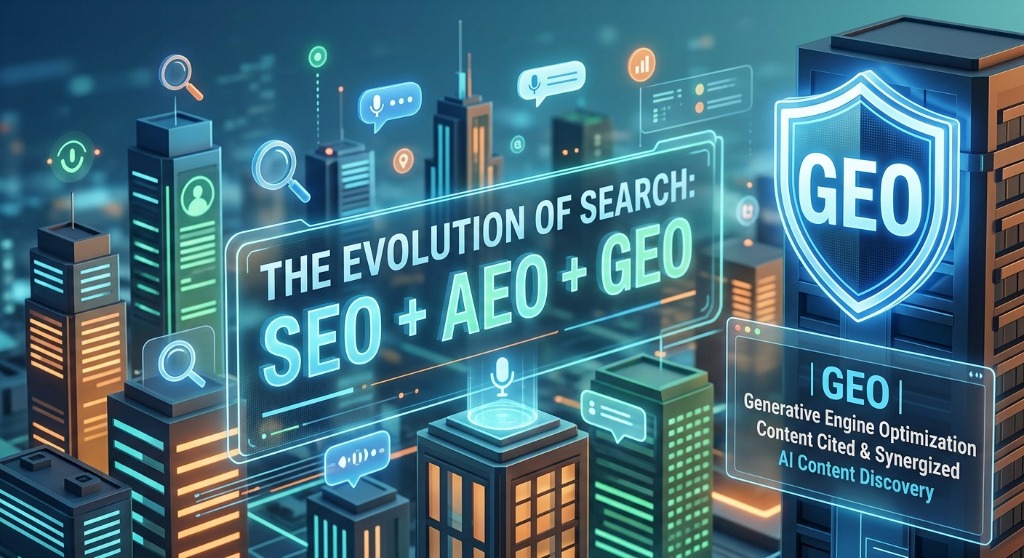
TL;DR: Search engine optimization is no longer just about ranking #1 on a traditional Google search results page. The digital landscape has evolved rapidly into a multi-faceted ecosystem powered by traditional algorithms, direct answer engines, and Generative AI. To maintain visibility and drive organic customer acquisition today, businesses must layer SEO (Search Engine Optimization), AEO (Answer Engine Optimization), and GEO (Generative Engine Optimization) into a unified growth strategy.
Last updated: October 22, 2026 | Author: Brandon Smith, CEO & Co-Founder, Treasure Coast A.I. Solutions | Category: Search & AI Strategy
The New Reality of Modern Search
Search engine optimization is no longer just about ranking #1 on a traditional Google search results page. The digital landscape has evolved rapidly into a multi-faceted ecosystem powered by traditional search crawlers, direct answer engines, and conversational Generative AI.
Prospective customers and homeowners no longer interact with search engines through simple ten-blue-links results alone. They ask Siri for immediate contractor recommendations, read Google AI Overviews directly at the top of SERPs, and prompt platforms like Perplexity, ChatGPT, and Claude to synthesize complex comparisons before booking a service.
To maintain visibility and drive consistent organic growth today, modern digital strategies must encompass three core frameworks:
- SEO (Search Engine Optimization)
- AEO (Answer Engine Optimization)
- GEO (Generative Engine Optimization)
Below is a comprehensive breakdown of what these acronyms mean, how they differ, and step-by-step strategies to implement them for your business.
1. What Are SEO, AEO, and GEO?
SEO (Search Engine Optimization)
- What it is: The practice of optimizing web content, technical architecture, and authority signals to rank higher on traditional search engine results pages (SERPs) like Google and Bing.
- Primary Goal: Drive organic traffic, website clicks, and brand discovery through keyword targeting, technical website performance, backlink acquisition, and responsive user experience.
- Target Platforms: Google SERPs, Bing, Yahoo, DuckDuckGo.
AEO (Answer Engine Optimization)
- What it is: The process of structuring and formatting content so search engines and voice assistants can effortlessly extract single, concise, authoritative answers to specific user questions.
- Primary Goal: Win zero-click searches, featured snippets, People Also Ask (PAA) boxes, knowledge graphs, and voice search results.
- Target Platforms: Google Featured Snippets, Google Assistant, Apple Siri, Amazon Alexa, and quick-answer modules inside AI search engines.
GEO (Generative Engine Optimization)
- What it is: The emerging discipline of structuring, verifying, and attributing content so AI-driven generative engines cite, synthesize, and reference your brand or website when composing multi-source AI answers.
- Primary Goal: Get cited, quoted, and recommended inside direct AI conversation models, search overviews, and conversational engines.
- Target Platforms: Google AI Overviews, ChatGPT Search, Perplexity AI, Claude, and Microsoft Copilot.
2. SEO vs. AEO vs. GEO: A Quick Comparison
Understanding how user behavior diverges across these three models reveals why relying solely on legacy SEO leaves massive blind spots in your pipeline.
| Feature | SEO (Search Engine Optimization) | AEO (Answer Engine Optimization) | GEO (Generative Engine Optimization) |
|---|---|---|---|
| User Intent | Discovery, browsing, resource gathering, exploratory research | Instant answers, quick factual lookups, step-by-step how-to queries | In-depth synthesis, side-by-side comparisons, tailored recommendations |
| Content Format | In-depth articles, comprehensive landing pages, hub-and-spoke topic clusters | Concise 40–60 word answer blurbs, bulleted lists, structured Q&A accordions | Authoritative data summaries, statistical benchmarks, verified case studies, cited expert insights |
| Success Metric | Organic clicks, website sessions, impression share, traditional SERP ranks | Featured snippet win rate, PAA placements, voice impression share | AI citations, brand sentiment, context inclusion, referral traffic from AI platforms |
| User Interaction | Query $\rightarrow$ Multiple SERP clicks $\rightarrow$ Browse web page | Question $\rightarrow$ Single definitive zero-click answer | Prompt $\rightarrow$ Synthesized response with footnote citations |
3. How to Implement and Utilize SEO, AEO, and GEO
To win in modern search, you do not choose one over the others—you layer them together into a unified strategy. A strong technical SEO foundation provides the indexability that AEO requires, while AEO's structured entities feed the citation confidence needed for GEO.
Step 1: Solidify Your Technical & Content SEO Foundation
Before an AI engine can cite your site, traditional web crawlers must be able to index and trust it.
- Optimize On-Page Elements: Target high-intent transactional and informational keywords in title tags, H1/H2 headings, meta descriptions, image alt tags, and internal link anchor text.
- Technical Performance & Core Web Vitals: Ensure sub-second initial server response times, high Google PageSpeed scores, zero layout shifts, and mobile-first responsive layouts.
- Build High-Quality Topical Authority: Secure authoritative backlinks from reputable local business directories, industry publications, and partner websites in your niche.
Step 2: Optimize for AEO (Capturing Direct Answers)
Answer engines prioritize content that minimizes ambiguity and answers user questions without requiring fluff or filler.
- Implement Rich Schema Markup: Deploy JSON-LD structured data—including
FAQPage,Article,HowTo,LocalBusiness, andProductschemas—so search bots parse your entities, business hours, and service locations deterministically. - Direct Answer Formatting: Place clean, direct answers at the very top of each content section in 40 to 60 words, immediately followed by detailed context, proof points, and explanations.
- Question-Based Headings: Structure your subheadings around natural language queries that mirror actual conversational search patterns (e.g., "How much does AC repair cost in Florida?" or "What is the difference between AEO and GEO?").
Step 3: Optimize for GEO (Winning AI Citations)
Generative models do not just match keywords; they evaluate semantic coherence, domain credibility, and factual density.
- Cite Hard Data and Original Research: Large language models heavily favor content containing original statistics, real-world case studies, benchmark numbers, and clear source attribution.
- Demonstrate Clear E-E-A-T: Emphasize Experience, Expertise, Authoritativeness, and Trustworthiness. Feature verifiable author bios, real company credentials, physical addresses, case studies, and transparent licensing details.
- Logical, Machine-Readable Formatting: Utilize clean Markdown tables, numbered steps, bulleted takeaway lists, and well-defined terminology definitions so LLM retrieval augmented generation (RAG) pipelines can easily chunk and extract your insights.
Frequently Asked Questions (FAQ)
Is SEO dead because of AI and direct answer engines?
No. Traditional SEO remains the foundational layer. AEO and GEO rely on the technical site health, indexing, crawlability, and domain authority established through robust SEO practices. If search bots cannot efficiently crawl and understand your domain, AI models will not discover or cite your content.
What is the difference between AEO and GEO?
While AEO focuses on extracting a direct, singular answer for specific queries (such as a Google featured snippet or a voice search answer on Siri), GEO focuses on being cited, recommended, and summarized within complex, multi-sentence AI-generated conversational responses across platforms like ChatGPT, Perplexity, and Google AI Overviews.
How do I measure GEO success if AI doesn't always send clicks?
GEO tracking focuses on AI citation frequency, brand mention sentiment inside AI outputs, referral traffic from AI platforms (like Perplexity.ai and ChatGPT), and growth in branded direct search volume as users discover your company via AI recommendations.
Ready to Elevate Your Search Strategy?
Staying ahead of search trends requires a proactive, holistic approach. Whether you need to audit your current website, restructure your content for AI answer engines, or build an end-to-end SEO/AEO/GEO strategy, our team of specialists is here to help.
👉 Schedule a Free Search Audit Today or Explore Our Core Services to future-proof your digital visibility!
Frequently Asked Questions
Is SEO dead because of AI and direct answer engines?
No. Traditional SEO remains the foundational layer. AEO and GEO rely on the technical site health, indexing, and domain authority established through robust SEO practices.
What is the difference between AEO and GEO?
While AEO focuses on extracting a direct, singular answer for specific queries (like featured snippets or voice answers), GEO focuses on being cited and summarized within complex AI-generated conversational responses.
How do I measure GEO success if AI doesn't always send clicks?
GEO tracking focuses on citation frequency, brand mention sentiment inside AI chat outputs, referral traffic from AI platforms (like Perplexity or ChatGPT), and overall brand search volume growth.
Can small and local businesses benefit from GEO and AEO?
Yes. Local queries like "best AC repair company near me" are increasingly answered directly by Google AI Overviews and ChatGPT Search. Having local schema markup, verified reviews, and clear entity definitions ensures your business is cited as the top recommendation.